Homeostasis Is a Term That Describes the Many
Homeostasis is a term coined to describe the physical and chemical parameters that an organism must maintain to allow proper functioning of its component cells tissues organs and organ systems. The difference between homeostasis as a single cell performs it and what a.

General Biology Pictures Of Biological Phenomena Endocrine System Endocrine Glands
A situation in which different elements are equal or in the correct proportions.

. The body maintains homeostasis by controlling a host of variables ranging from body temperature blood. It is dynamic because it is constantly adjusting to the changes that the systems encounter. Term used to describe normal fluctuations around a setpoint in homeostasis.
It requires a constant balance. If the calcium in your blood decreases below homeostasis levels a gland in the brain will sense the decrease and send a chemical message to your bones. Controlling such things as body temperature blood pH and the amount of glucose in the blood are among the ways the body works to maintain homeostasis.
Homeostasis is a core concept necessary for understanding the many regulatory mechanisms in physiology. Homeostasis refers to stability balance or equilibrium within a cell or the body. Homeostatic mechanisms regulate the body by neg-ative or positive feedback.
The many processes by which the body controls its internal environment are collectively called homeostasis. Walter Cannon introduced the term homeostasis and expanded Bernards notion of constancy of the internal environment in an. Negative feedback occurs when a change in a.
For example your body shivers to maintain a relatively constant body temperature when the external environment gets colder. The characteristic of an organism to regulate its internal conditions. Homeostasis is a term which describes the process whereby the body ________.
Homeostasis and Negative and Positive Feedback 9 Terms. It is an organisms ability to keep a constant internal environment. Homeostasis is a term that describes the many _____ processes to maintain the _____ of the body.
Homeostasis refers to the maintenance of relatively constant internal conditions. Furthermore homeostasis is a self-regulating process that regulates internal variables necessary to sustain life. Homeostasis is a core concept necessary for understanding the many regulatory mechanisms in physiology.
Claude Bernard originally proposed the concept of the constancy of the milieu interieur but his discussion was rather abstract. See answer 1 Best Answer. It was thought that this kind of homeostasis could help to explain why forests grasslands or other ecosystems persist that is remain in the same location for long periods.
Maintain homeostasis in an environment when. In biology homeostasis is the state of steady internal physical and chemical conditions maintained by living systems. To maintain homeostasis your body adapts two types of feedback mechanisms.
The complementary activity of major body systems maintains homeostasis. 13 Homeostasis and Feedback Loops 20 Terms. The control center is generally the nervous system or _____ system.
Homeostasis is a term that describes many ______ processes to maintain the ______ of the body. These characteristics are noted about homeostatic systems. The term homeostasis has been used by many ecologists to describe the back-and-forth interaction that occurs between the different parts of an ecosystem to maintain the status quo.
They are _____ and continually change. Add your answer and earn points. Homeostasis is a dynamic equilibrium that is maintained in body tissues and organs.
There must be normal concentrations of nutrients oxygen and water. Structure in a feedback mechanism that detects a change. These characteristics are noted about homeostatic systems1.
Homeostasis is the maintenance of a stable internal environment. They are _____ and continually change. KashDAbash3452 is waiting for your help.
Homeostasis and Negative and Positive Feedback 9 Terms. It is in equilibrium because body functions are kept within a normal range with some fluctuations around a set point for the processes. A more formal definition of homeostasis is a characteristic of a system that regulates its internal environment and tends to maintain a stable relatively constant condition of.
Claude Bernard originally proposed the concept of the constancy of the milieu interieur but his discussion was rather abstract. In biology the term homeostasis refers to the ability of the body to maintain a stable internal environment despite changes in external conditions. The control center is generally the nervous system or.
Heat and pressure must be regulated at tolerable levels. Homeostasis is the term used to describe the internal stability needed for survival of an organism including humans and animals. Homeostasis is a term that describes a stable internal body environment.
Staying in balance term that is used to both describe the survival of organisms in an ecosystem and to describe the successful survival of cells inside of an organism. What is another word for homeostasis. In other words homeostasis is a mechanism that maintains a stable internal environment despite the changes present in the external environment.
This is the condition of optimal functioning for the organism and includes many variables such as body temperature and fluid balance being kept within certain pre-set limits homeostatic range.
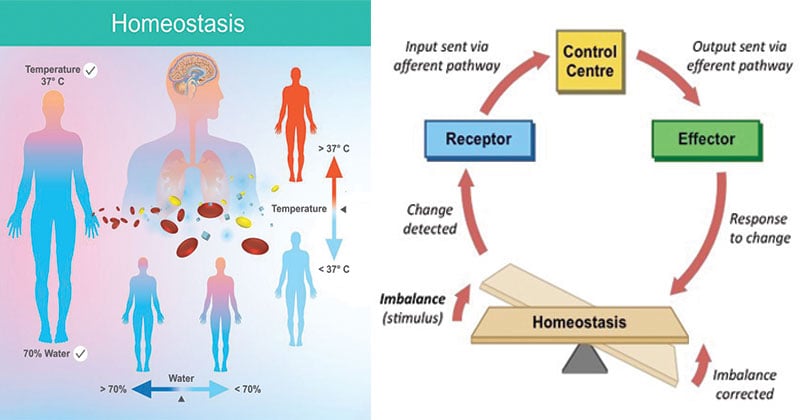
Homeostasis Definition Types Examples Applications

Dr Josh Axe Dc Dnm Cns On Instagram Did You Know That Itis Is A Suffix Meaning Inflammation Dermatitis For Example Means In Josh Axe Inflammation Cns
Erythrocyte Production Is Controlled Via A Negative Feedback Loop Oxygen Levels Are Monitored And During Hypoxic C Red Bone Marrow Respiratory Care Physiology


Comments
Post a Comment